
The SOLID Principles Every Software Engineer Should Know
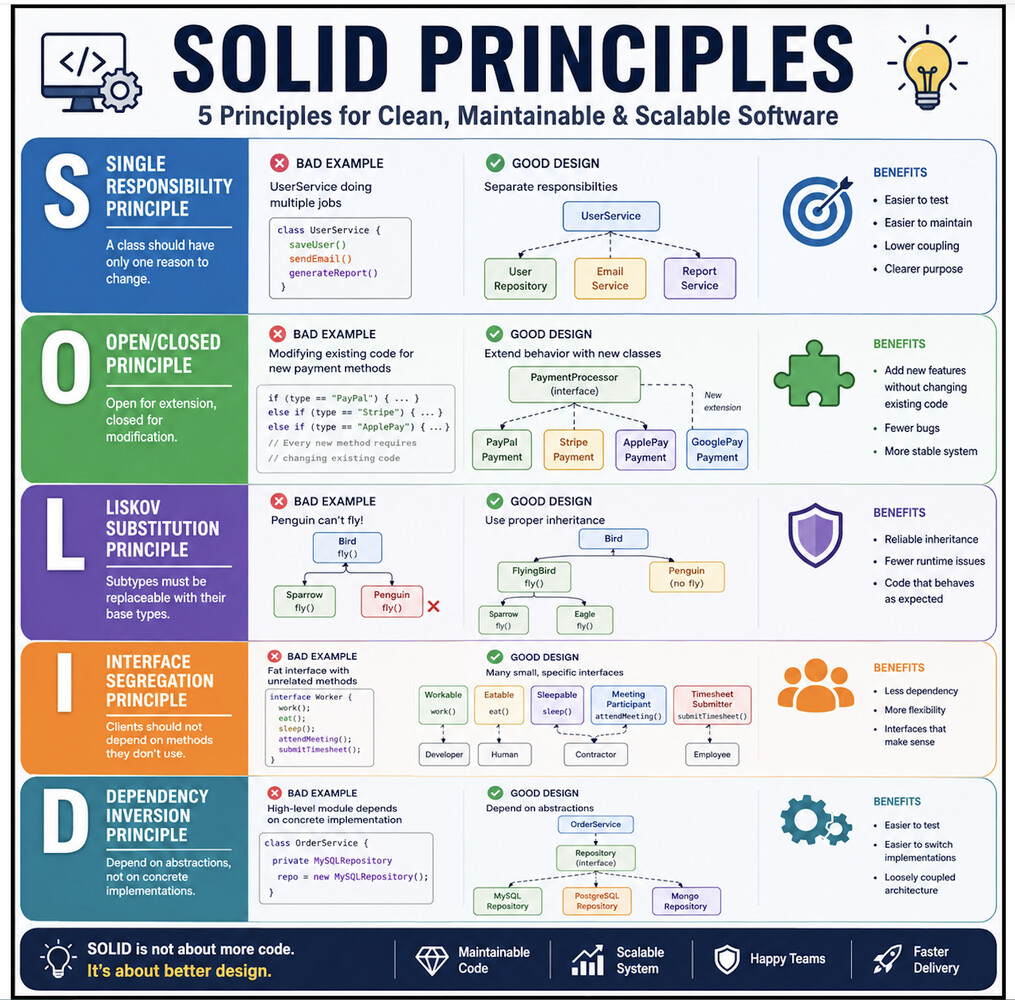
"Why do some codebases become impossible to maintain after just a year, while others remain clean after a decade?"
The difference is rarely the programming language.
It's usually the design.
Whether you're building a small REST API or a distributed microservices platform, following the SOLID principles can dramatically improve maintainability, scalability, and testability.
Let's break them down with practical examples.
S — Single Responsibility Principle (SRP)
A class should have only one reason to change.
Many developers misunderstand SRP as "one method per class."
That's not the point.
A class should have one responsibility, not multiple unrelated jobs.
❌ Bad Example
public class UserService {

    public void saveUser(User user) {
        // Save to database
    }

    public void sendWelcomeEmail(User user) {
        // Send email
    }

    public void generateReport() {
        // Generate PDF report
    }
}
This class handles:
Persistence
Email
Reporting
Three different responsibilities.
✅ Better Design
UserService
     │
     ├── UserRepository
     ├── EmailService
     └── ReportService
Each class has one job.
Benefits:
Easier testing
Smaller changes
Better readability
Lower coupling
O — Open/Closed Principle (OCP)
Open for extension, closed for modification.
When new requirements arrive, you should add code—not rewrite existing code.
❌ Bad Example
if(payment.equals("PayPal")){
    ...
}
else if(payment.equals("Stripe")){
    ...
}
else if(payment.equals("ApplePay")){
    ...
}
Every new payment method requires editing existing logic.
✅ Better Design
interface PaymentProcessor{
    void pay();
}
Implementations:
StripePayment
PaypalPayment
ApplePayPayment
processor.pay();
Adding Google Pay?
Simply create:
GooglePayProcessor
No existing code changes.
That's scalability.
L — Liskov Substitution Principle (LSP)
Subclasses should be replaceable by their parent class.
If replacing a parent with a child breaks your application, you've violated LSP.
❌ Famous Example
Bird
 ├── Sparrow
 └── Penguin
If Bird.fly() exists...
Penguin cannot fly.
Bad inheritance.
✅ Better Design
Bird
 ├── FlyingBird
 │      ├── Sparrow
 │      └── Eagle
 │
 └── Penguin
Now the hierarchy reflects reality.
Inheritance models behavior—not assumptions.
I — Interface Segregation Principle (ISP)
Clients should not depend on methods they don't use.
Avoid giant interfaces.
❌ Bad Example
interface Worker {

    work();

    eat();

    sleep();

    attendMeeting();

    submitTimesheet();
}
A robot worker doesn't eat.
A contractor may not submit timesheets.
✅ Better Design
Split interfaces.
Workable

Eatable

Sleepable

MeetingParticipant
Classes implement only what they need.
Cleaner.
Smaller.
More reusable.
D — Dependency Inversion Principle (DIP)
Depend on abstractions, not concrete implementations.
This principle powers modern frameworks like Spring Boot.
❌ Tight Coupling
class OrderService{

    private MySQLRepository repo =
        new MySQLRepository();
}
Switching to PostgreSQL?
You'll modify OrderService.
✅ Better Design
interface Repository
Implementations
MySQLRepository
PostgreSQLRepository
MongoRepository
Inject dependency.
OrderService(Repository repo)
Spring Boot does this automatically using Dependency Injection.
This makes applications:
Easier to test
Easier to replace implementations
Easier to scale
How SOLID Helps in Real Projects
Imagine you're building an e-commerce platform.
Without SOLID:
❌ Every feature touches dozens of files.
❌ Regression bugs increase.
❌ Unit testing becomes painful.
❌ Adding payment providers becomes risky.
❌ New developers struggle to understand the system.
With SOLID:
✅ New features plug into existing architecture.
✅ Business logic stays isolated.
✅ Components become reusable.
✅ Testing is straightforward.
✅ Refactoring becomes much safer.
SOLID and Modern Architecture
SOLID isn't just for object-oriented programming.
The same ideas appear in:
Spring Boot applications
Microservices
Domain-Driven Design (DDD)
Clean Architecture
Hexagonal Architecture
Event-Driven Systems
Plugin-based systems
AI Agent architectures
Good architecture is simply SOLID applied at a larger scale.
Common Misconceptions
❌ SOLID means more classes
Not necessarily.
It means better separation of concerns.
❌ SOLID makes development slower
Initially, maybe.
Long term?
It dramatically reduces maintenance cost.
❌ SOLID only matters for enterprise systems
Even a side project grows.
Today's 500 lines often become tomorrow's 50,000.
Design early.
Final Thoughts
The best engineers don't just write code that works.
They write code that still works—and is still easy to understand—years later.
SOLID isn't about memorising five principles.
It's about creating software that's easier to change than to replace.
As Robert C. Martin famously said:
"The only way to go fast is to go well."
Master SOLID, and you'll build software that scales not only in traffic—but also in maintainability.
Which SOLID principle do you think is violated most often in real-world projects?
Share your experience in the comments—I’d love to hear your perspective.