
The Difference Between Reliable and Resilient Systems
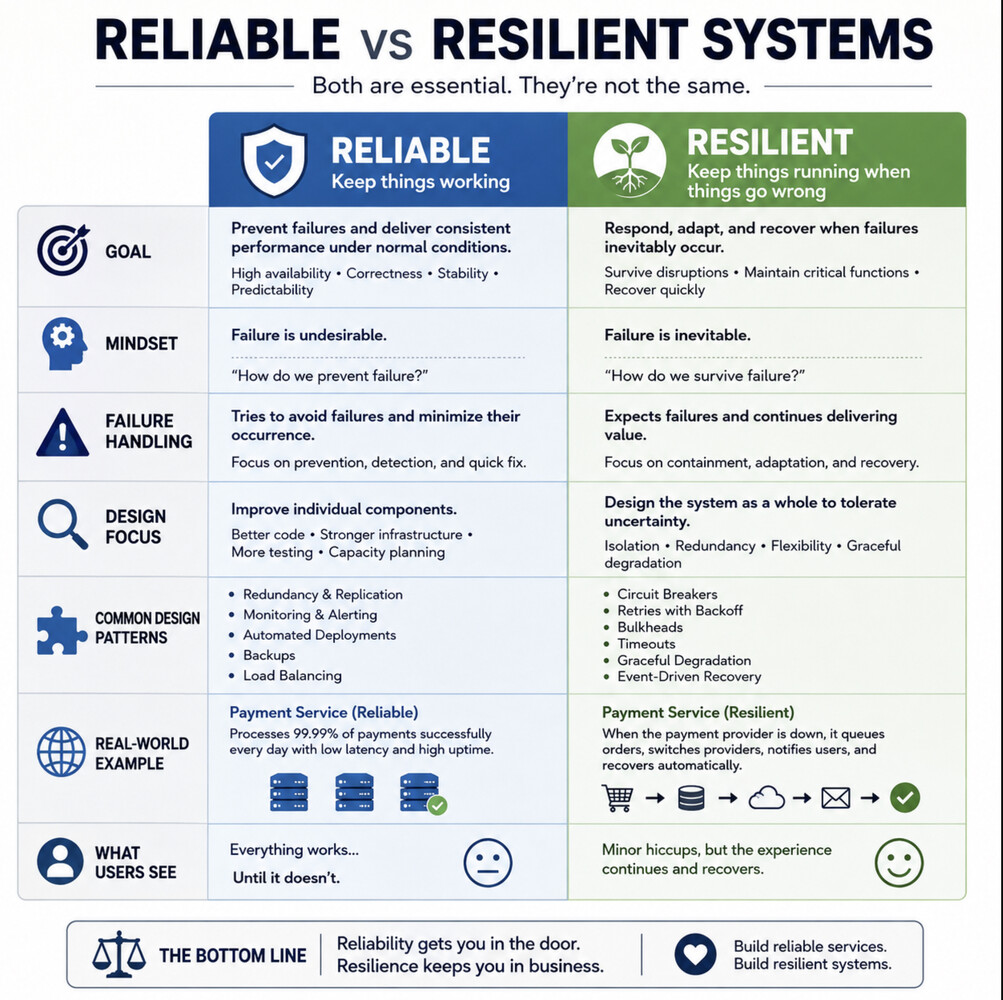
Many engineers use reliability and resilience interchangeably.
They're not the same.
And misunderstanding the difference often leads to architectures that perform perfectly in testing—but fail when real-world chaos arrives.
After designing distributed systems for decades, I've learned one simple truth:
Reliable systems aim to prevent failure. Resilient systems assume failure is inevitable.
That mindset changes everything.
Reliability: Keeping Things Working
A reliable system consistently performs its intended function under expected operating conditions.
Its goal is straightforward:
High availability
Correct functionality
Stable performance
Predictable behavior
Reliability focuses on minimizing failures before they happen.
Typical techniques include:
Redundant hardware
Unit and integration testing
Monitoring
Automated deployments
Database replication
High-quality code reviews
Capacity planning
Imagine an online payment service.
If it processes 99.99% of payments successfully every day, most people would call it reliable.
And they'd be right.
But here's the question that matters:
What happens when something unexpected occurs?
Resilience: Thriving During Failure
Resilience is different.
It measures how well a system responds, adapts, and recovers when things inevitably go wrong.
Failures are not exceptions.
They're expected.
Examples include:
Network partitions
Cloud region outages
Database failures
Dependency timeouts
Traffic spikes
Human mistakes
Configuration errors
A resilient system doesn't pretend these won't happen.
It prepares for them.
Instead of asking:
"How do we prevent failure?"
It asks:
"How do we survive failure?"
Reliable Systems Can Still Fail Catastrophically
Consider two e-commerce platforms.
Platform A
99.99% uptime
Fast response times
Excellent monitoring
Highly optimized database
Everything works beautifully.
Until the payment provider becomes unavailable.
Suddenly:
Orders fail
Checkout stops
Customers leave
Revenue disappears
The platform was reliable.
But it wasn't resilient.
Platform B
It experiences the same outage.
Instead of failing completely, it:
Queues pending orders
Accepts carts for delayed payment
Switches to a backup payment provider
Notifies customers automatically
Recovers once the provider returns
Customers experience minor delays.
Business continues.
That's resilience.
Reliability is About Components
Reliability often improves individual components.
Examples include:
Better databases
Faster APIs
Stronger testing
More stable infrastructure
Every service becomes more dependable.
But distributed systems don't fail one component at a time.
They fail through interactions.
That's where resilience begins.
Resilience is About the Entire System
Modern architectures contain dozens—or hundreds—of services.
Even if every service is 99.9% reliable:
Dependencies fail
Networks become slow
Messages arrive late
APIs return partial responses
Caches become stale
The architecture must continue delivering value despite these conditions.
Resilience is therefore a system-level property, not a component property.
Common Resilience Patterns
Some of the most effective architectural patterns include:
Circuit Breakers
Prevent cascading failures by temporarily stopping calls to unhealthy services.
Retries with Backoff
Handle transient failures without overwhelming downstream services.
Bulkheads
Isolate failures so one overloaded service doesn't take down the entire platform.
Timeouts
Never wait forever.
Slow services should fail fast.
Graceful Degradation
If recommendations fail...
Still allow checkout.
If notifications fail...
Still process payments.
Not every feature is equally important.
Event-Driven Recovery
Instead of blocking users synchronously:
Publish events
Retry asynchronously
Recover automatically
Users experience fewer failures while the system heals itself.
Chaos Engineering Changes the Conversation
Traditional testing asks:
Does the system work?
Chaos engineering asks:
Does the system still work when everything starts breaking?
Organizations like Netflix popularized intentionally introducing failures into production because resilience cannot be proven by perfect conditions.
It must be demonstrated under imperfect ones.
AI Makes Resilience Even More Important
AI-powered systems introduce new types of uncertainty.
LLMs may:
Return inconsistent responses
Hit rate limits
Experience high latency
Produce invalid outputs
Become temporarily unavailable
Building AI applications therefore requires architectural resilience.
Successful systems include:
Fallback models
Prompt retries
Response validation
Confidence thresholds
Human approval workflows
Cached responses
The question is no longer:
"Is the model available?"
It's:
"How does the application continue delivering value when the model isn't?"
Reliability + Resilience = Production Excellence
The best architectures pursue both.
Reliability ensures systems work well.
Resilience ensures systems continue working when reality becomes messy.
You need both.
Because production isn't defined by your happy path.
It's defined by everything that happens after the happy path breaks.
Final Thoughts
Great software engineers build reliable services.
Great architects build resilient systems.
The difference isn't just technical.
It's philosophical.
Reliable systems try to avoid failure.
Resilient systems learn how to live with it.
And in distributed systems, that difference often determines whether users notice a minor hiccup—or your company experiences a major outage.
What architectural pattern has improved resilience the most in your systems?
I'd love to hear your experience in the comments.