
Microservices Design Patterns: The Patterns Every Software Architect Should Know
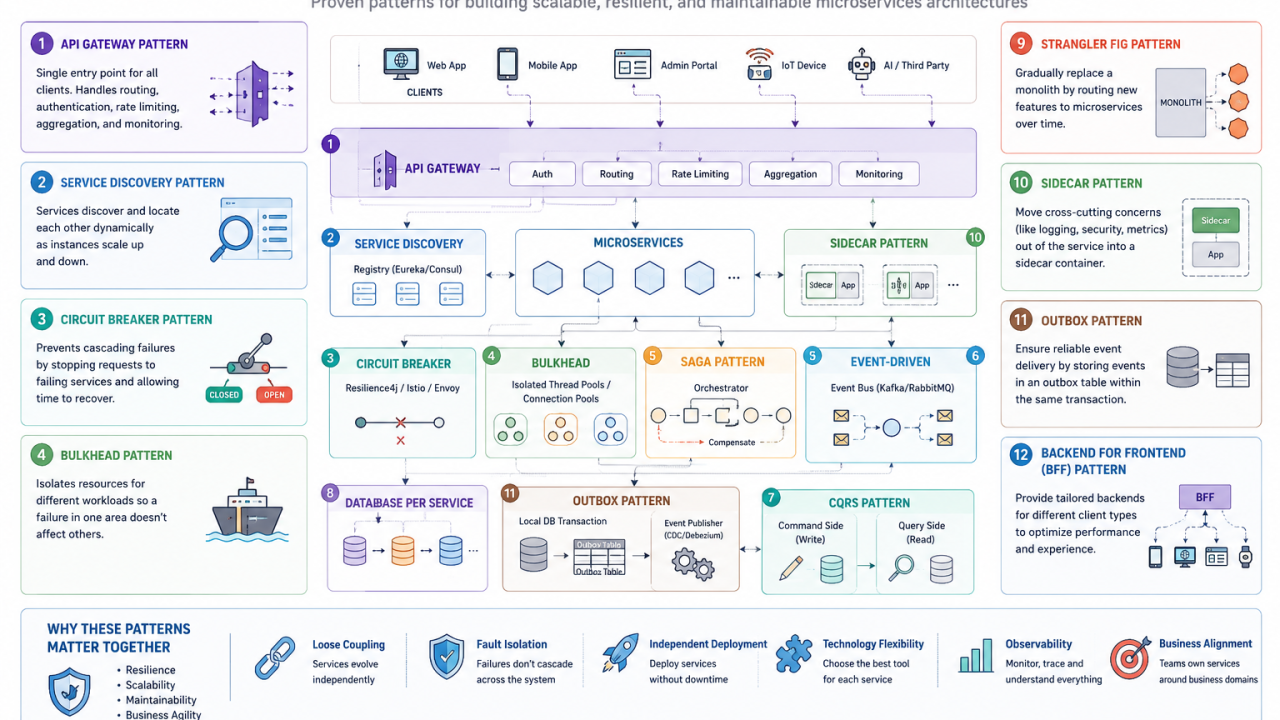
Most developers think microservices are about splitting a monolith.
They're not.
Microservices are actually about managing complexity after the split.
The hardest problems don't appear when you create services.
They appear when hundreds of services start talking to each other.
How do you maintain consistency without distributed transactions?
How do you prevent cascading failures?
How do you discover services dynamically?
How do you deploy independently without downtime?
How do you trace a single request across dozens of services?
These aren't coding problems.
They're architecture problems.
And architecture problems are solved with design patterns.
After working on distributed systems for years, I've learned that successful microservice platforms aren't built around frameworks.
They're built around patterns.
Here are the design patterns every software architect should understand.
1. API Gateway Pattern
Without an API Gateway, every client communicates directly with every service.
The result?
A tangled web of APIs.
Clients must know service locations, authentication mechanisms, versions, rate limits, and routing rules.
An API Gateway becomes the single entry point.
It handles:
Authentication
Authorization
Rate limiting
SSL termination
Request routing
API aggregation
Monitoring
Instead of every service solving the same problems repeatedly, the gateway centralizes them.
Popular technologies include:
Spring Cloud Gateway
Kong
NGINX
Envoy
Azure API Management
AWS API Gateway
2. Service Discovery Pattern
In Kubernetes or cloud-native environments, service IP addresses constantly change.
Hardcoding endpoints is impossible.
Service Discovery allows services to locate each other dynamically.
Two common approaches:
Client-side discovery
The client queries the registry directly.
Examples:
Eureka
Consul
Server-side discovery
A load balancer or service mesh resolves service locations.
Examples:
Kubernetes DNS
Istio
Linkerd
Without service discovery, scaling becomes painful.
3. Circuit Breaker Pattern
One failing service should never bring down the entire platform.
Unfortunately, that's exactly what happens in many distributed systems.
Imagine:
Service A → Service B → Service C
If Service C becomes slow...
B waits.
A waits.
Threads become blocked.
Connection pools fill up.
Soon the entire application becomes unavailable.
A Circuit Breaker monitors failures.
After a threshold is reached, it "opens" and immediately rejects requests instead of waiting for inevitable failures.
After a recovery period, it allows limited requests to test whether the downstream service has recovered.
Popular implementations:
Resilience4j
Istio
Envoy
4. Bulkhead Pattern
Ships have bulkheads for a reason.
If one compartment floods, the entire ship doesn't sink.
Software should work the same way.
Instead of sharing one thread pool for everything:
Payment
Search
User Profile
Notifications
each critical function gets isolated resources.
A failure in one workload cannot consume resources needed by another.
Bulkheads dramatically improve resilience during incidents.
5. Saga Pattern
Distributed transactions don't scale.
Two-Phase Commit introduces latency, complexity, and availability issues.
Instead, modern systems use Sagas.
A Saga breaks one business transaction into multiple local transactions.
Example:
Customer places an order.
Reserve inventory
Create order
Process payment
Arrange shipment
Send confirmation
If payment fails...
The system compensates.
Release inventory
Cancel order
instead of rolling back a distributed transaction.
Two implementation styles exist:
Choreography
Services react to events independently.
Orchestration
A central workflow coordinates each step.
Workflow engines like Camunda, Temporal, and Netflix Conductor simplify orchestration significantly.
6. Event-Driven Pattern
Synchronous APIs create tight coupling.
Every request depends on another service responding immediately.
Event-driven architecture changes this.
Instead of asking another service to perform work...
A service publishes an event.
Other services subscribe independently.
Example:
Order Created
      │
      ├── Inventory Service
      ├── Payment Service
      ├── Shipping Service
      ├── Analytics Service
      └── Notification Service
Benefits:
Loose coupling
Better scalability
Higher resilience
Easier feature expansion
Technologies include:
Kafka
RabbitMQ
Azure Service Bus
Google Pub/Sub
7. CQRS Pattern
Not every workload should use the same model for reads and writes.
Large systems often receive thousands of reads for every write.
CQRS separates them.
Command Side
Create
Update
Delete
Query Side
Read
Search
Reporting
Each side can scale independently.
This greatly improves performance for read-heavy systems.
8. Database per Service Pattern
Sharing a database creates hidden coupling.
Soon every service depends on everyone else's schema.
One database change affects multiple teams.
Database per Service solves this.
Each service owns its data.
Communication happens only through APIs or events.
This enables:
Independent deployment
Independent scaling
Technology diversity
Team autonomy
It also enforces proper service boundaries.
9. Strangler Fig Pattern
Few organizations can rewrite an entire monolith.
Instead...
Replace it gradually.
The Strangler Pattern routes new functionality to microservices while existing features continue running inside the monolith.
Over time:
Monolith
      ↓
Monolith + Services
      ↓
Mostly Services
      ↓
Monolith Removed
This minimizes risk while enabling continuous modernization.
10. Sidecar Pattern
Some capabilities shouldn't live inside application code.
Examples include:
Logging
Metrics
Security
TLS
Service discovery
Configuration
Instead, deploy them as a companion container.
The application focuses on business logic.
The sidecar handles infrastructure concerns.
Service meshes rely heavily on this pattern.
11. Outbox Pattern
One of the hardest problems in distributed systems is ensuring that a database update and an event publication either both happen or neither does.
Imagine:
Save an order to the database ✅
Publish "OrderCreated" event ❌
Now the database says the order exists, but no downstream service knows about it.
The Outbox Pattern solves this by writing both the business data and an "outbox" event in the same local transaction. A separate process reliably publishes the event afterward.
This pattern is widely used with Kafka and Change Data Capture (CDC) tools such as Debezium to achieve reliable event delivery.
12. Backend for Frontend (BFF) Pattern
Different clients often have different API needs.
A mobile app, a web application, and an admin portal shouldn't all consume the same backend API.
The Backend for Frontend (BFF) pattern provides a dedicated backend for each client type.
Benefits include:
Optimized payloads
Reduced over-fetching
Independent frontend evolution
Better user experience
This pattern has become increasingly important as organizations support web, mobile, IoT, and AI-powered interfaces simultaneously.
Common Mistakes I Still See
Many microservice projects fail—not because the technology is wrong, but because the architecture is incomplete.
Some recurring mistakes include:
Sharing databases across services
Using synchronous calls everywhere
Ignoring idempotency in event processing
Missing distributed tracing and observability
Treating eventual consistency as a bug instead of a design principle
Splitting services before identifying clear domain boundaries
Choosing microservices for small teams with simple products
Microservices amplify both good and bad architecture. Without clear boundaries and operational discipline, they create complexity faster than they create value.
Final Thoughts
There is no "perfect" microservice architecture.
Every successful platform is a combination of patterns chosen to solve specific business and operational challenges.
The most resilient systems rarely rely on a single pattern. Instead, they combine several:
API Gateway for controlled access
Service Discovery for dynamic routing
Circuit Breakers and Bulkheads for resilience
Sagas and Outbox for reliable distributed workflows
Event-Driven Architecture for loose coupling
CQRS for scalability
Database per Service for autonomy
Sidecars for infrastructure concerns
BFF for client-specific experiences
Great software architects don't memorize patterns.
They understand when to apply them, why they work, and what trade-offs they introduce.
That's what separates systems that survive production from systems that merely work in development.
Which microservices design pattern has had the biggest impact on your architecture—or taught you the hardest lesson? Share your experience in the comments.