
Frontend Architecture Patterns Every Senior Frontend Developer Should Know
Modern frontend applications are no longer just a collection of pages and components.
They're distributed systems running inside a browser.
Today's enterprise applications must handle millions of users, multiple teams, micro-frontends, real-time updates, offline support, AI-powered features, accessibility, and continuous deployment—all while remaining fast and maintainable.
The difference between a junior frontend developer and a senior one isn't writing better React, Angular, or Vue components.
It's understanding architecture.
Here are the frontend architecture patterns every senior frontend developer should know.
1. Component-Based Architecture
Everything starts with reusable components.
Instead of building pages directly, modern frameworks encourage building independent UI building blocks.
Benefits include:
Reusability
Testability
Consistency
Easier maintenance
Good components are:
Small
Focused
Stateless whenever possible
Easy to compose
Think in Lego bricks—not giant pages.
2. Container / Presentational Pattern
Separate what users see from how data is managed.
Presentational components:
Render UI
Receive data via props
Emit events
Container components:
Fetch data
Manage state
Handle business logic
Benefits:
Easier testing
Better separation of concerns
Improved reusability
Even with React Hooks, this pattern remains highly valuable.
3. Feature-Based Architecture
Many projects organize code like this:
components/
services/
hooks/
utils/
pages/
This works…
Until the project reaches hundreds of components.
A better approach:
features/

authentication/
dashboard/
orders/
customers/
reports/
Each feature owns:
Components
API calls
State
Tests
Styles
Business logic
Large companies almost always organize by business capability rather than file type.
4. Atomic Design
Atomic Design breaks UI into multiple layers:
Atoms
Molecules
Organisms
Templates
Pages
This creates:
Consistent design systems
Reusable components
Easier UI scaling
Many enterprise design systems follow this approach.
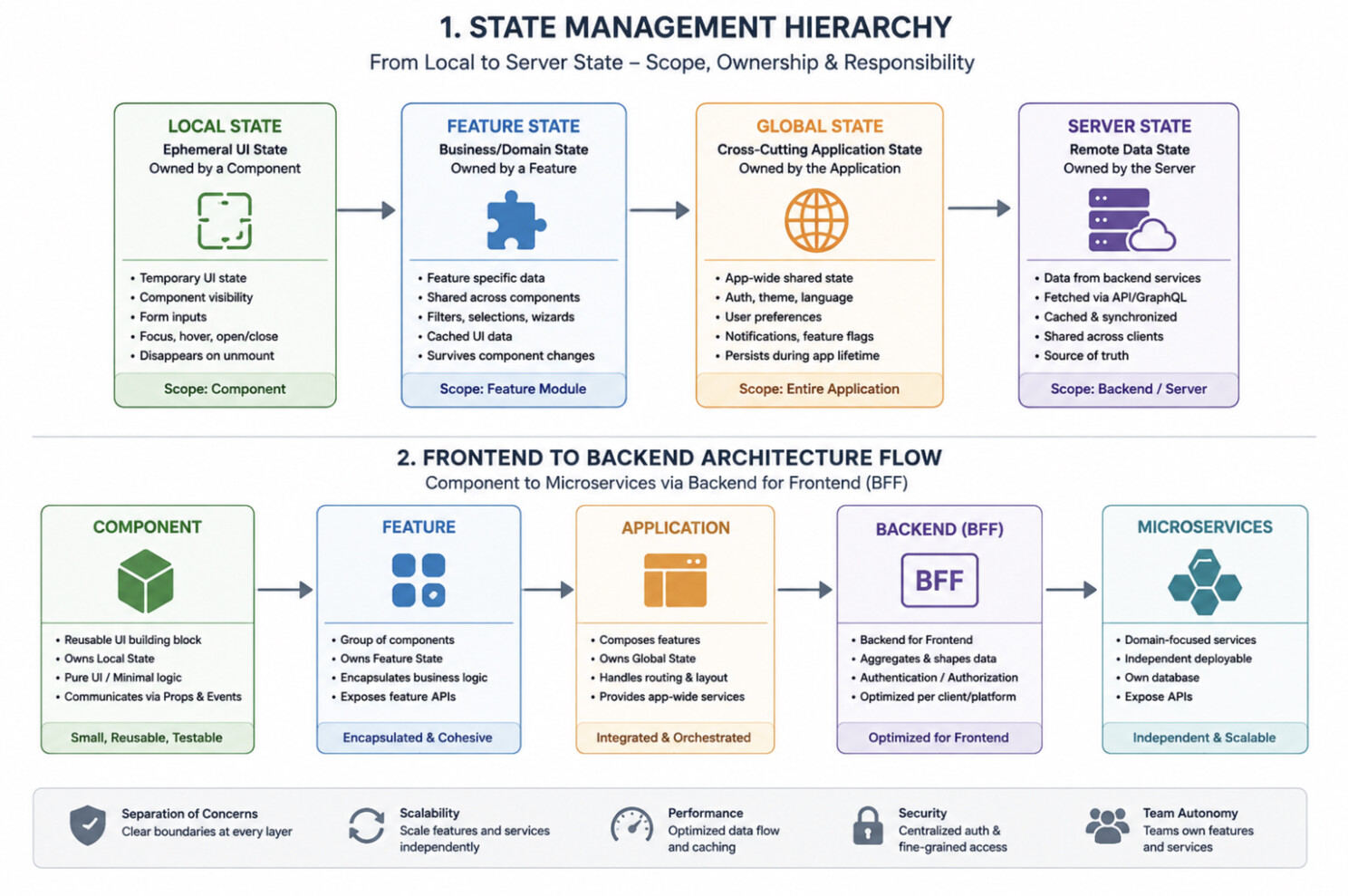
5. Smart State Management
Not all state belongs in Redux, NgRx, Pinia, or Vuex.
A common strategy is:
Local State
Form inputs
Modal visibility
Tabs
Feature State
Shopping cart
User profile
Search filters
Global State
Authentication
Theme
User settings
Server State
API responses
Cache
Pagination
Queries
One of the biggest architectural mistakes is putting everything into global state.
6. Unidirectional Data Flow
One-way data flow makes applications predictable.
Instead of components modifying each other's state:
User Action
      ↓
State Update
      ↓
UI Re-render
Benefits:
Easier debugging
Better testing
Predictable rendering
Cleaner architecture
React popularized this idea, but it benefits every frontend framework.
7. Dependency Injection
Angular developers know this well.
Instead of creating services directly:
new ApiService()
Inject them.
Benefits:
Loose coupling
Easier testing
Better mocking
Replaceable implementations
Dependency Injection isn't just an Angular feature—it's an architectural principle.
8. Backend for Frontend (BFF)
Different clients often require different APIs.
Instead of exposing dozens of microservices directly:
Browser
     ↓
Backend For Frontend
     ↓
Microservices
Benefits:
Simpler frontend
Fewer API calls
Better security
Client-specific optimization
Large enterprise systems increasingly adopt the BFF pattern.
9. Micro-Frontend Architecture
Large organizations often have hundreds of frontend developers.
Instead of one massive application:
Team A owns Billing
Team B owns Orders
Team C owns Customers
Team D owns Reports
Each deploys independently.
Benefits:
Independent releases
Team autonomy
Faster development
Smaller codebases
Popular approaches include:
Module Federation
Single-SPA
Native Web Components
Micro-frontends aren't for every project, but they're powerful at enterprise scale.
10. Design System Architecture
A mature frontend organization doesn't repeatedly build buttons.
Instead, it creates a shared design system containing:
Buttons
Inputs
Tables
Dialogs
Icons
Typography
Colors
Layout primitives
Benefits:
Consistent UX
Faster development
Easier accessibility
Reduced duplication
Companies like Google, Microsoft, Shopify, and Atlassian have invested heavily in design systems because they scale.
11. API Layer Abstraction
Avoid scattering HTTP calls throughout your components.
Instead:
UI
 ↓
Service Layer
 ↓
API Client
 ↓
REST / GraphQL
Benefits:
Easier maintenance
Better testing
Centralized error handling
Cleaner components
Your UI should care about business data—not HTTP details.
12. Lazy Loading & Code Splitting
Loading every feature upfront hurts performance.
Instead:
Lazy routes
Dynamic imports
Component-level splitting
Deferred loading
Benefits:
Faster initial load
Smaller bundles
Better Core Web Vitals
Improved user experience
Performance is an architectural concern—not just an optimization.
13. Event-Driven Frontend
Not every component should communicate directly.
Instead:
Event Bus
Pub/Sub
Custom Events
RxJS Observables
Useful for:
Notifications
Analytics
Cross-module communication
Plugin architectures
This reduces tight coupling between features.
14. Offline-First Architecture
Modern users expect applications to keep working even with unreliable networks.
Key technologies include:
Service Workers
Local Storage
IndexedDB
Background Sync
Cache API
Offline-first design improves resilience and user satisfaction.
15. AI-Ready Frontend Architecture
AI is rapidly becoming part of everyday applications.
Modern frontend architecture should anticipate:
AI chat interfaces
AI copilots
Semantic search
Streaming responses
MCP tool integrations
Real-time agent interactions
Design your frontend so AI capabilities can be added without rewriting the application.
Future-proof architecture matters.
Common Architecture Mistakes
Even experienced teams often struggle with these pitfalls:
Massive global state stores
Components with excessive responsibilities
Tight coupling between UI and APIs
Business logic embedded in components
Duplicated code across features
No design system
Over-engineering simple applications
Ignoring performance until production
Poor folder organization
Inconsistent state ownership
Architecture problems rarely appear in the first month—they emerge after years of continuous development.
Final Thoughts
Frameworks evolve every few years.
Architecture principles last much longer.
Whether you're building applications with React, Angular, Vue, Svelte, or the next generation of AI-assisted frameworks, the most successful frontend teams share the same characteristics:
Clear separation of concerns
Predictable state management
Reusable components
Scalable feature organization
Consistent design systems
Performance by design
Loose coupling
Maintainable codebases
Senior frontend developers aren't defined by how many frameworks they know.
They're defined by the architectural decisions they make—decisions that enable teams to deliver software faster, scale confidently, and adapt to future technologies.
Which frontend architecture pattern has had the biggest impact on your projects? Share your experience in the comments.