
Designing Systems for AI Agents
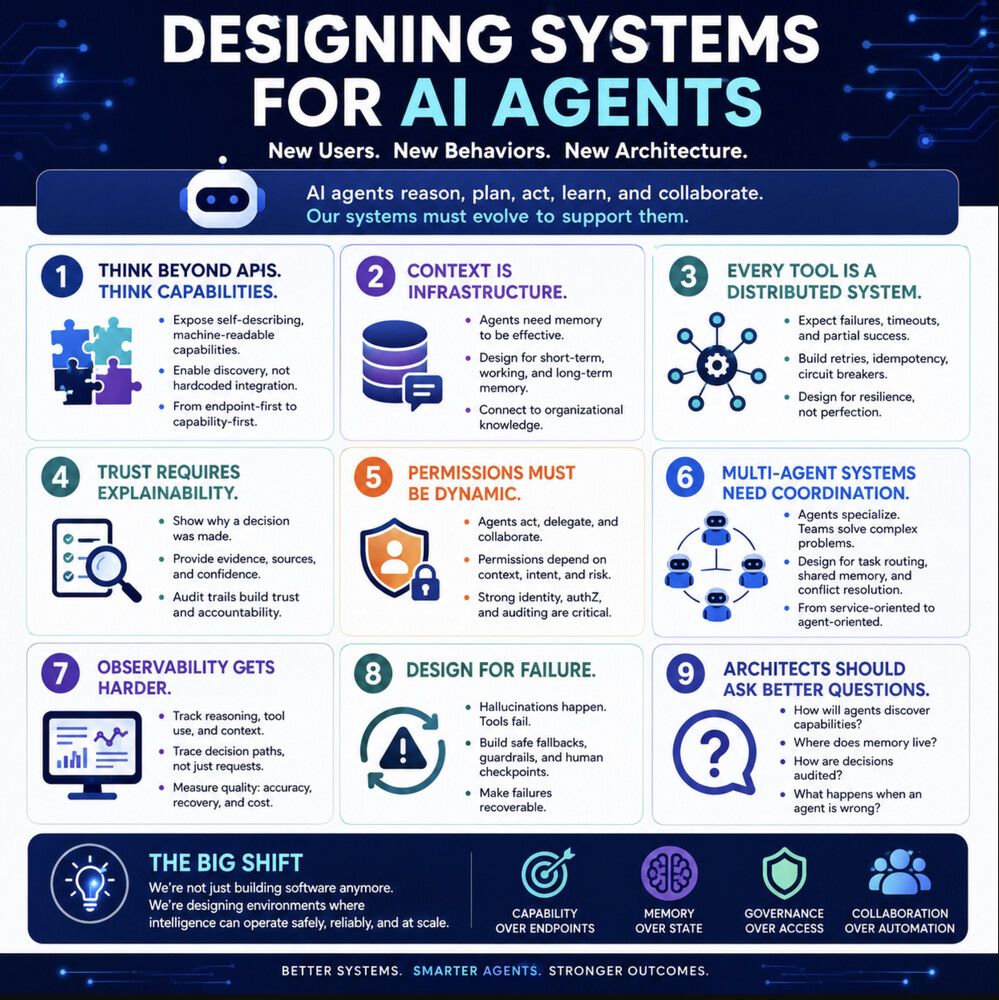
We spent decades designing systems for humans.
What happens when your primary users become AI agents instead?
Most software isn't ready.
For years, software architecture has revolved around one assumption:
Humans make decisions. Software executes them.
A user clicks a button.
A backend validates the request.
A database stores the result.
An API returns a response.
The software is deterministic, predictable, and largely stateless between interactions.
AI agents completely change that model.
Instead of following predefined workflows, agents reason, plan, remember, collaborate, call tools, recover from failures, and continuously adapt.
That means we're no longer designing applications.
We're designing ecosystems where autonomous software entities operate.
The Architecture Shift
Traditional architecture asks:
How do users interact with the system?
How should services communicate?
How do we scale traffic?
Agentic architecture asks different questions:
How does an agent discover capabilities?
How does it decide which tool to use?
How does it recover from uncertainty?
How do multiple agents collaborate safely?
How do we observe reasoning that isn't deterministic?
Those questions didn't exist five years ago.
Today, they're becoming the most important design decisions.
Think Beyond APIs
Traditional systems expose APIs.
Agent systems expose capabilities.
Instead of:
POST /orders
An agent thinks:
"I need to create an order."
Then discovers available tools:
CreateOrder
SearchInventory
EstimateShipping
ValidatePayment
NotifyCustomer
The interface becomes semantic instead of procedural.
Instead of calling endpoints directly, agents choose capabilities based on context.
This requires APIs to become:
self-describing
discoverable
machine-readable
version-aware
The future isn't API-first.
It's capability-first.
Context Becomes Infrastructure
Traditional applications treat context as temporary.
Agents treat context as memory.
An agent may need to remember:
previous conversations
earlier decisions
business constraints
user preferences
failed attempts
retrieved documents
external knowledge
Suddenly, context is no longer just prompt engineering.
It's infrastructure.
Modern systems need multiple layers of memory:
Short-term
Current conversation.
Working memory
Active task state.
Long-term memory
Persistent knowledge.
Organizational knowledge
Documentation, policies, architecture decisions, code repositories, tickets, and databases.
Without effective context management, even the smartest LLM behaves like someone suffering from amnesia.
Every Tool Is a Distributed System
When an AI agent calls a tool, it isn't making a simple API request.
It's orchestrating distributed systems.
One task may involve:
ERP
CRM
payment gateways
email services
Slack
GitHub
databases
cloud storage
vector search
One reasoning step may trigger dozens of network calls.
Failures become normal.
Timeouts become expected.
Partial success becomes common.
Agent platforms therefore need:
retries
idempotency
circuit breakers
compensation
rollback strategies
observability
Ironically, many "AI problems" are actually classic distributed systems problems.
Trust Requires Explainability
Traditional applications rarely explain why they made a decision.
Agents must.
Imagine an AI approving a $500,000 loan.
Would you trust:
"The model said yes."
Probably not.
Instead, organizations need:
evidence used
confidence scores
source citations
reasoning summaries
policy references
decision history
Explainability isn't a nice-to-have.
It's a production requirement.
Permissions Must Become Dynamic
Traditional RBAC assumes humans.
Agents are different.
They may:
act on behalf of users
delegate tasks
collaborate with other agents
temporarily elevate permissions
call external systems
Permissions become contextual.
Questions evolve into:
Can this agent:
read this document?
execute this tool?
spend this budget?
modify production?
approve payments?
Identity, authorization, and auditing become central architecture concerns.
Multi-Agent Systems Need Coordination
One agent rarely solves everything.
Imagine an enterprise platform:
Planner Agent
↓
Research Agent
↓
Coding Agent
↓
Testing Agent
↓
Deployment Agent
↓
Monitoring Agent
↓
Incident Response Agent
Now architecture looks less like microservices and more like an intelligent workforce.
The challenge isn't creating agents.
The challenge is coordinating them.
That requires:
task routing
shared memory
conflict resolution
event orchestration
workflow recovery
governance
We're moving from Service-Oriented Architecture to Agent-Oriented Architecture.
Observability Gets Harder
Traditional monitoring tracks:
latency
CPU
memory
requests
errors
Agent systems require much more.
We need visibility into:
reasoning paths
tool selection
prompt versions
retrieved knowledge
token usage
decision chains
hallucination rates
recovery attempts
Logs become conversations.
Tracing becomes reasoning graphs.
Dashboards become execution timelines.
Designing for Failure
Agents will make mistakes.
That's guaranteed.
Good systems assume:
hallucinations happen
tools fail
APIs change
context is incomplete
users give ambiguous instructions
models disagree
Production-ready agent systems include:
✅ Human approval checkpoints
✅ Safe fallback workflows
✅ Retry strategies
✅ Rollback mechanisms
✅ Guardrails
✅ Continuous evaluation
Reliability isn't achieved by making AI perfect.
It's achieved by making failures recoverable.
What Architects Should Focus On
Instead of asking:
Which LLM should we use?
Start asking:
How will agents discover capabilities?
Where does memory live?
How is context managed?
How do agents collaborate?
How are permissions enforced?
How are decisions audited?
How do we observe reasoning?
What happens when an agent is wrong?
Those questions will shape the next generation of software architecture.
Final Thoughts
The biggest misconception about AI is that it's just another feature.
It isn't.
It's a new execution model.
Over the past two decades, we've evolved from monoliths to microservices, embraced cloud-native platforms, adopted event-driven architectures, and built resilient distributed systems.
Now we're entering another transformation.
We're designing systems where software doesn't simply execute instructions—it makes decisions, coordinates actions, and collaborates autonomously.
The architects who succeed won't be the ones who choose the best model.
They'll be the ones who build the best systems around the model.
Because in the age of AI agents, architecture is no longer just about software.
It's about designing environments where intelligence can operate safely, reliably, and at scale.
What architectural principle do you think will matter most in the era of AI agents—context, memory, observability, governance, or something else? I'd love to hear your perspective.