
Building Resilient Microservices on AWS
High availability is no longer enough. Modern cloud applications must be designed to survive failures—not just avoid them.
Microservices have become the de facto architecture for modern enterprise applications. They enable independent deployments, faster innovation, and elastic scaling. But they also introduce an unavoidable reality:
Failures are no longer exceptional—they're expected.
Network latency, downstream service failures, infrastructure outages, message duplication, and sudden traffic spikes are all part of running distributed systems in production.
The question isn't:
"Will something fail?"
The real question is:
"When something fails, how much of your system fails with it?"
That's where resilience engineering comes in.
In this article, I'll walk through the AWS services, architectural patterns, and engineering practices that help build microservices capable of surviving real-world failures.
Why Resilience Matters
Traditional monolithic applications often fail as a single unit.
Distributed microservices fail differently.
A single request may travel through multiple services:
Client
   │
API Gateway
   │
Order Service
   │
Inventory Service
   │
Payment Service
   │
Notification Service
If the Payment Service becomes slow, should customers still be able to browse products?
If Notifications fail, should orders stop being created?
The answer should always be No.
Resilient systems isolate failures instead of allowing them to cascade.
Core Principles of Resilient Microservices
Before choosing AWS services, understand these principles.
Design for Failure
Assume every dependency can fail.
Every API call should have:
Timeouts
Retries
Circuit Breakers
Fallback strategies
Hope is not an architectural strategy.
Loose Coupling
Services should know as little about each other as possible.
Prefer:
Event-driven communication
Asynchronous messaging
Well-defined APIs
Avoid tightly coupled request chains whenever possible.
Stateless Services
Stateless services scale more easily and recover faster.
Store state in managed services such as:
Amazon DynamoDB
Amazon Aurora
Amazon ElastiCache
Amazon S3
instead of application memory.
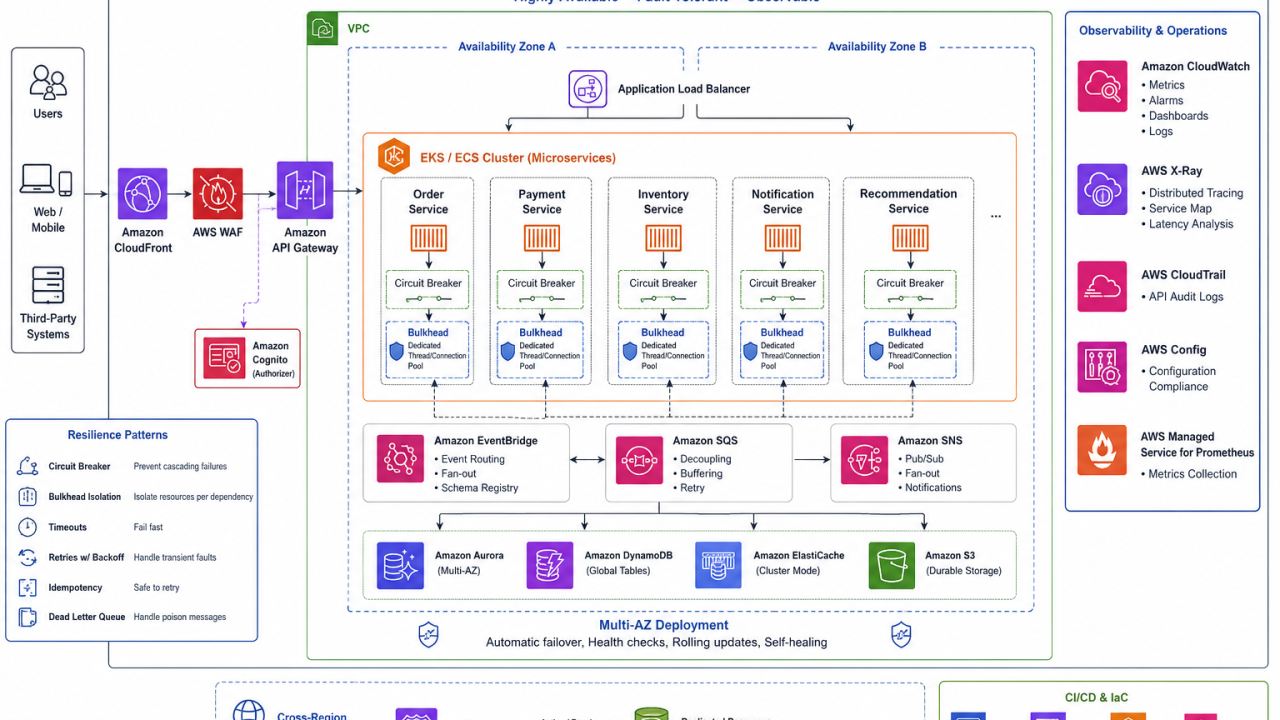
AWS Architecture for Resilient Microservices
A typical production architecture might look like this:
Users
   │
Amazon CloudFront
   │
AWS WAF
   │
Amazon API Gateway
   │
Elastic Load Balancer
   │
Amazon EKS / Amazon ECS / AWS Lambda
   │
────────────────────────────────────
Order Service
Inventory Service
Payment Service
Notification Service
Recommendation Service
────────────────────────────────────
        │
Amazon SQS
Amazon SNS
Amazon EventBridge
Amazon MSK (Kafka)
        │
────────────────────────────────────
Amazon Aurora
Amazon DynamoDB
Amazon ElastiCache
Amazon S3
────────────────────────────────────
CloudWatch
AWS X-Ray
AWS CloudTrail
Each layer contributes to resilience.
Asynchronous Messaging
One of the biggest causes of cascading failures is synchronous communication.
Instead of:
Order → Payment → Inventory → Shipping
consider:
Order Created
      │
 EventBridge
      │
 ┌────┼────┐
 │    │    │
Payment Inventory Shipping
Benefits include:
Reduced coupling
Independent scaling
Better fault tolerance
Improved throughput
AWS provides several messaging options:
Amazon SQS
Amazon SNS
Amazon EventBridge
Amazon MSK (Managed Kafka)
Choose the right tool based on ordering, fan-out, replay, and event-routing requirements.
Timeouts
Never allow requests to wait indefinitely.
A slow dependency is often more damaging than a failed dependency.
Configure reasonable timeout values for:
HTTP clients
Database connections
Message consumers
External APIs
Fail fast.
Recover quickly.
Retries with Exponential Backoff
Transient failures happen.
Examples include:
Temporary network issues
Brief service overload
AWS throttling
Instead of retrying immediately:
1 sec

2 sec

4 sec

8 sec
Exponential backoff reduces pressure on already struggling systems.
Combine retries with jitter to prevent retry storms.
Circuit Breakers
Repeatedly calling an unhealthy service only makes the situation worse.
Circuit breakers monitor failures and temporarily stop sending requests.
Healthy
   │
Failures increase
   │
Circuit Opens
   │
Traffic blocked
   │
Recovery detected
   │
Half Open
   │
Healthy Again
Popular Java implementations include:
Resilience4j
Spring Cloud Circuit Breaker
Bulkhead Isolation
Imagine every downstream dependency sharing the same thread pool.
If one service becomes slow:
Threads become exhausted
Other services cannot execute
The entire application becomes unresponsive
Bulkheads isolate resources.
For example:
Payment Pool
20 Threads

Inventory Pool
15 Threads

Notification Pool
5 Threads
Now failures remain isolated.
This is one of the most overlooked resilience patterns.
Idempotency
Distributed systems often retry requests.
Without idempotency:
A customer clicks "Pay" once.
The request times out.
The client retries.
The payment is processed twice.
Use:
Idempotency keys
Unique request IDs
Conditional writes
AWS services such as DynamoDB make implementing idempotency straightforward.
Eventual Consistency
Microservices rarely share a single database.
Instead, each service owns its own data.
Maintaining strict ACID transactions across services is usually impractical.
Instead, embrace:
Event-driven architecture
Saga Pattern
Outbox Pattern
Eventual consistency
These approaches improve scalability while maintaining business correctness.
Auto Scaling
Traffic is unpredictable.
AWS Auto Scaling enables applications to grow automatically.
Examples:
Amazon ECS Service Auto Scaling
Amazon EKS Cluster Autoscaler
EC2 Auto Scaling Groups
AWS Lambda automatic scaling
Scale only what needs to scale.
Multi-AZ and Multi-Region
Availability Zones exist for a reason.
Deploy production workloads across multiple AZs.
For mission-critical systems, consider:
Multi-Region architectures
Route 53 failover
Aurora Global Database
DynamoDB Global Tables
Design for regional resilience—not just instance resilience.
Observability
You cannot fix what you cannot see.
Every production system should collect:
Metrics
Amazon CloudWatch
CPU
Memory
Latency
Error rates
Queue depth
Logs
Centralized structured logging.
Avoid searching hundreds of containers individually.
Distributed Tracing
AWS X-Ray reveals request flows across services.
Tracing quickly identifies bottlenecks that traditional logs cannot.
Security Is Part of Resilience
Security failures are availability failures.
Use:
IAM least privilege
Secrets Manager
AWS KMS
Amazon Cognito
AWS WAF
AWS Shield
VPC Security Groups
A resilient application must also be a secure application.
Chaos Engineering
Production should not be the first place you discover weaknesses.
Introduce controlled failures.
Examples:
Kill service instances
Increase latency
Simulate database failures
Disconnect message brokers
AWS Fault Injection Service (FIS) enables teams to validate resilience before real incidents occur.
Common Mistakes
Many teams adopt microservices but forget resilience.
Common pitfalls include:
No timeout configuration
Unlimited retries
Synchronous service chains
Shared thread pools
Missing circuit breakers
No distributed tracing
Shared databases
No idempotency
Ignoring backpressure
Testing only the happy path
Microservices alone do not improve reliability.
Good engineering does.
Final Thoughts
Building resilient microservices isn't about eliminating failures.
It's about ensuring failures remain small, isolated, and recoverable.
AWS provides an exceptional ecosystem for resilience—from API Gateway, EventBridge, SQS, and DynamoDB to EKS, CloudWatch, X-Ray, and Fault Injection Service.
But technology alone isn't enough.
Resilience comes from thoughtful architecture, disciplined engineering practices, and a mindset that assumes failure is inevitable.
The most successful cloud-native systems aren't the ones that never fail.
They're the ones that continue delivering value when failure happens.
What resilience patterns have made the biggest difference in your production systems? I'd love to hear your experiences in the comments.