
Building AI Agents with Amazon Bedrock
Artificial Intelligence has moved beyond chatbots.
Today's enterprises are building AI agents capable of reasoning, planning, retrieving knowledge, invoking APIs, orchestrating business workflows, and collaborating with other systems autonomously.
But while many tutorials demonstrate how to build a chatbot in a few lines of code, very few explain what it takes to build production-ready AI agents that are scalable, secure, observable, and maintainable.
Amazon Bedrock provides a strong foundation for doing exactly that.
In this article, I'll explore how modern AI agents can be built on AWS using Amazon Bedrock, and the architectural patterns that matter in real enterprise environments.
Why AI Agents Instead of Simple Chatbots?
Traditional chatbots generally follow a straightforward pattern:
User
   ↓
LLM
   ↓
Response
They generate text—but they rarely take action.
AI agents, on the other hand, are designed to accomplish goals.
Instead of simply answering questions, they can:
Search enterprise knowledge bases
Query databases
Call REST or GraphQL APIs
Execute business workflows
Create support tickets
Generate reports
Schedule meetings
Invoke Lambda functions
Collaborate with other AI agents
The LLM becomes the reasoning engine—not the entire application.
What Amazon Bedrock Provides
Amazon Bedrock removes much of the operational complexity involved in enterprise AI development.
Rather than managing GPUs or hosting foundation models yourself, Bedrock offers fully managed access to multiple leading models through a unified API.
Developers can work with models from providers such as:
Anthropic Claude
Amazon Nova
Meta Llama
Mistral AI
Cohere
AI21 Labs
Stability AI
This flexibility allows teams to choose the best model for each workload without redesigning the application architecture.
Different models excel at different tasks:
reasoning
coding
summarization
multilingual conversations
document analysis
image generation
Bedrock makes switching between them remarkably straightforward.
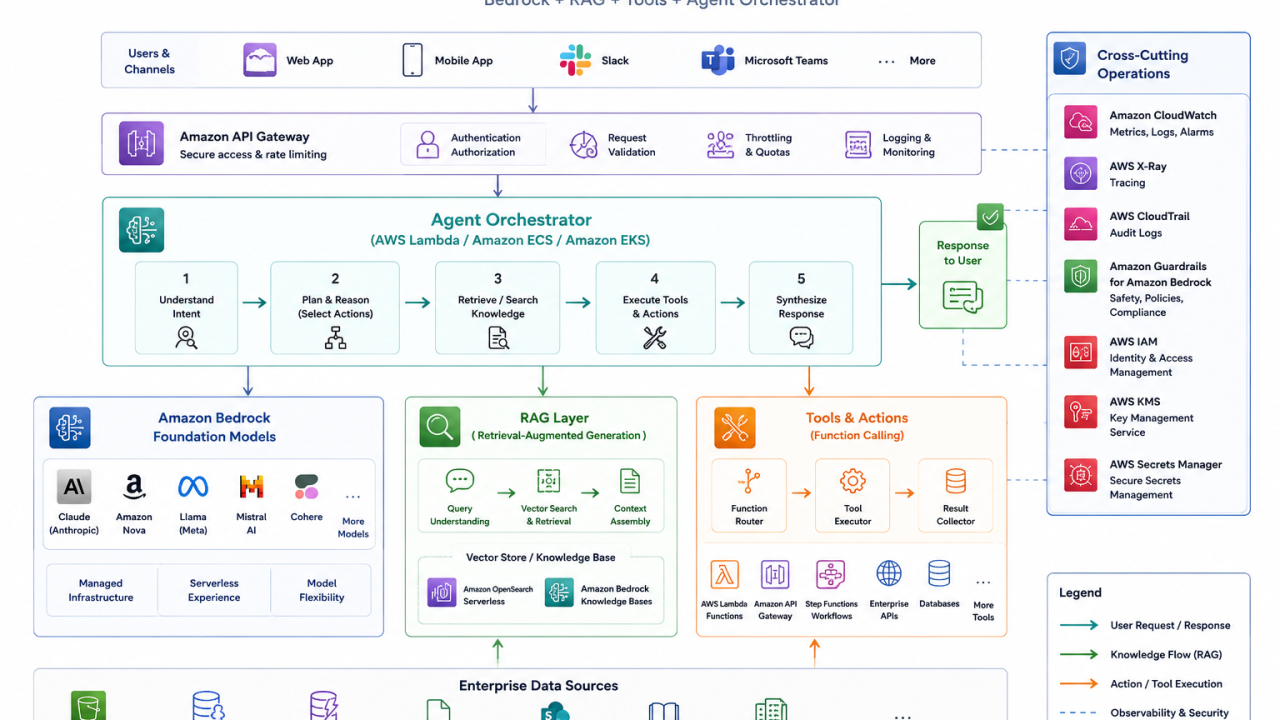
The Architecture of an Enterprise AI Agent
A production AI agent is far more than an LLM.
A typical architecture looks like this:
 User
                  │
                  ▼
           API Gateway
                  │
                  ▼
         Agent Orchestrator
                  │
      ┌───────────┼────────────┐
      ▼           ▼            ▼
 Amazon Bedrock  RAG      Business APIs
      │           │            │
      ▼           ▼            ▼
Foundation     Vector DB    Enterprise
Models         Knowledge     Systems
                  │
                  ▼
             Monitoring
             Security
             Logging
Every component has a distinct responsibility.
The LLM reasons.
The orchestrator decides.
External systems execute business operations.
Knowledge systems provide context.
Observability platforms ensure reliability.
Bedrock Agents
One of Bedrock's most interesting capabilities is Agents for Amazon Bedrock.
Instead of manually writing complex orchestration logic, developers can define:
Instructions
Goals
Available tools
Knowledge sources
API integrations
The agent determines:
what information to retrieve
which APIs to call
when to invoke tools
how to complete the user's objective
This significantly reduces application complexity.
Retrieval-Augmented Generation (RAG)
Enterprise AI should not rely solely on a model's training data.
Instead, responses should be grounded in current organizational knowledge.
Bedrock integrates well with:
Amazon OpenSearch
Amazon Aurora
Amazon S3
Knowledge Bases for Amazon Bedrock
Vector databases
A typical workflow is:
User Question
       │
       ▼
Vector Search
       │
Relevant Documents
       │
       ▼
Prompt Assembly
       │
       ▼
Amazon Bedrock
       │
       ▼
Grounded Response
This dramatically reduces hallucinations while keeping answers aligned with internal documentation.
Giving Agents Real Capabilities
The real power of AI agents comes from tools.
Rather than asking the model to imagine an answer, we allow it to perform real work.
Examples include:
Checking inventory
Creating orders
Processing refunds
Querying CRM systems
Sending emails
Deploying infrastructure
Running SQL queries
Triggering AWS Lambda
Invoking Step Functions
Calling internal microservices
The model decides which tool should be used.
The application executes it securely.
Multi-Agent Systems
As systems become more sophisticated, a single agent often becomes insufficient.
Many organizations are adopting specialized agents.
For example:
Customer Agent
Handles customer conversations.
↓
Knowledge Agent
Retrieves enterprise documentation.
↓
Workflow Agent
Coordinates business processes.
↓
Finance Agent
Processes billing requests.
↓
Security Agent
Validates permissions and compliance.
This separation improves scalability, maintainability, and governance.
Security Matters
Enterprise AI must never bypass existing security controls.
Some important considerations include:
IAM-based authorization
VPC isolation
Encryption at rest
Encryption in transit
Guardrails
Prompt filtering
Input validation
Output validation
Audit logging
Role-based access control
Amazon Bedrock integrates naturally with the broader AWS security ecosystem, making it easier to satisfy enterprise governance requirements.
Observability Is Essential
One of the biggest mistakes teams make is treating AI like a black box.
Production systems require visibility into:
latency
token consumption
model selection
API failures
hallucination rate
retrieval quality
user feedback
tool execution
workflow success rate
Without observability, improving AI systems becomes largely guesswork.
Choosing the Right Foundation Model
There is no universally "best" model.
The right choice depends on your workload.
For example:
Claude excels at long-form reasoning and enterprise conversations.
Amazon Nova provides strong AWS-native integration and competitive performance.
Llama models offer flexibility and customization.
Cohere performs well for retrieval and enterprise search.
Mistral is often attractive for efficient inference.
A mature architecture allows models to evolve independently from the rest of the application.
A Modern Enterprise AI Stack on AWS
One practical technology stack might include:
Amazon Bedrock
AWS Lambda
API Gateway
Amazon OpenSearch
Amazon S3
Amazon Aurora PostgreSQL
Amazon EventBridge
Step Functions
Amazon CloudWatch
Amazon Cognito
Amazon DynamoDB
Amazon ECS or EKS
LangChain or Spring AI for orchestration
Terraform for Infrastructure as Code
GitHub Actions or AWS CodePipeline for CI/CD
This combination supports scalable, resilient, cloud-native AI applications.
Lessons Learned
After working on enterprise systems for many years, one pattern keeps emerging:
The success of AI projects rarely depends on the language model itself.
It depends on architecture.
The best AI agents are not those with the most powerful models.
They are the ones that:
retrieve trusted information
execute business actions safely
integrate cleanly with enterprise systems
remain observable
scale reliably
evolve without major redesigns
Amazon Bedrock provides an excellent platform for building these capabilities—but success ultimately comes from thoughtful software architecture rather than model selection alone.
As AI agents become a standard component of enterprise applications, software engineers who understand orchestration, retrieval, security, and distributed systems will be well positioned to lead the next generation of intelligent platforms.
What architectural challenge have you encountered when building AI agents? I'd love to hear your experience and discuss the patterns that have worked in production.