
Beyond the Hype: How Multi-Agent Workflows Solve Complex Software Development
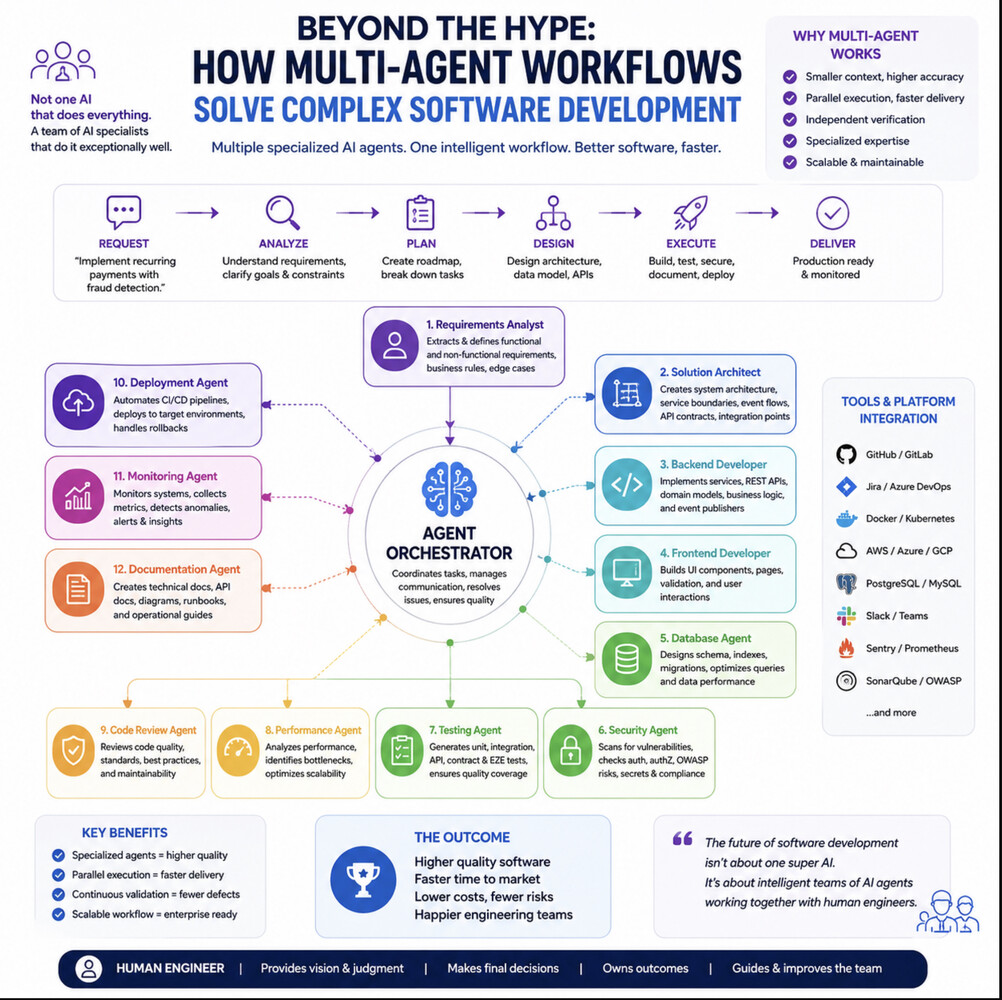
Artificial Intelligence is no longer limited to autocomplete, code generation, or chatbots.
The next evolution is AI systems that collaborate with other AI systems.
This is where multi-agent workflows come in.
While a single AI model can generate code, explain concepts, or answer questions, complex software development involves dozens of interconnected tasks happening simultaneously. No senior engineer tries to do everything alone—and neither should AI.
The future isn't one super-intelligent agent.
It's multiple specialised agents working together like an elite engineering team.
Why Single AI Agents Hit a Ceiling
Today's coding assistants are impressive.
They can:
Generate functions
Write unit tests
Explain unfamiliar code
Refactor methods
Produce documentation
But building enterprise software is far more than writing code.
Real projects require:
Understanding business requirements
Breaking work into manageable tasks
Designing system architecture
Reviewing code quality
Performing security analysis
Validating performance
Running tests
Deploying applications
Monitoring production systems
A single AI context window eventually becomes overloaded.
As responsibilities grow, quality declines.
Just as organisations divide work among specialists, AI benefits from the same principle.
Think of an Enterprise Engineering Team
Imagine building an online banking platform.
You wouldn't ask one engineer to:
Design the architecture
Implement APIs
Build the frontend
Write infrastructure code
Review pull requests
Perform penetration testing
Configure Kubernetes
Optimise databases
Monitor production
Instead, you assemble specialists.
Multi-agent systems apply exactly the same idea.
Each agent owns one responsibility.
Each performs it exceptionally well.
A Typical Multi-Agent Development Workflow
Instead of one AI attempting everything, imagine this pipeline:
Product Owner Agent
        │
        ▼
Planning Agent
        │
        ▼
System Architect Agent
        │
        ▼
Task Decomposition Agent
        │
        ▼
Backend Agent
Frontend Agent
Database Agent
Infrastructure Agent
        │
        ▼
Integration Agent
        │
        ▼
Testing Agent
        │
        ▼
Security Agent
        │
        ▼
Performance Agent
        │
        ▼
Code Review Agent
        │
        ▼
Documentation Agent
        │
        ▼
Deployment Agent
        │
        ▼
Monitoring Agent
Every agent has:
A clearly defined goal
Specific tools
Dedicated memory
Limited responsibilities
Well-defined inputs and outputs
This dramatically reduces context overload while improving consistency.
Example: Building a Payment Service
Imagine a request arrives:
"Implement recurring payments with fraud detection."
Instead of one AI doing everything...
Agent 1 — Requirements Analyst
Extracts:
Functional requirements
Non-functional requirements
Business rules
Edge cases
Agent 2 — Solution Architect
Produces:
Service boundaries
Event flows
Database design
API contracts
Integration points
Agent 3 — Backend Developer
Creates:
Spring Boot services
REST APIs
Domain models
Event publishers
Agent 4 — Frontend Developer
Builds:
React or Angular pages
Validation logic
User interactions
Agent 5 — Database Agent
Designs:
Tables
Indexes
Migration scripts
Query optimisation
Agent 6 — Security Agent
Reviews:
Authentication
Authorisation
OWASP vulnerabilities
Secret management
Input validation
Agent 7 — Testing Agent
Generates:
Unit tests
Integration tests
API tests
Contract tests
End-to-end tests
Agent 8 — Performance Agent
Checks:
Slow SQL
API latency
Memory usage
Caching opportunities
Load bottlenecks
Agent 9 — Documentation Agent
Produces:
API documentation
Architecture diagrams
Runbooks
Operational guides
Each agent contributes independently.
Together they deliver a significantly more complete solution than one overloaded assistant.
Why Multi-Agent Systems Produce Better Results
1. Smaller Contexts, Better Accuracy
Each agent focuses on one problem.
No unnecessary information.
Less hallucination.
Higher precision.
2. Parallel Execution
Multiple agents can work simultaneously.
For example:
Backend implementation
Frontend development
Database modelling
Infrastructure provisioning
can all happen in parallel.
Development becomes dramatically faster.
3. Independent Verification
One agent writes code.
Another reviews it.
Another tests it.
Another checks security.
This mirrors how experienced engineering organisations maintain quality.
4. Specialised Expertise
Different prompts produce different strengths.
Some agents specialise in:
Architecture
Security
Databases
Kubernetes
DevOps
UI/UX
Performance
Documentation
Rather than asking one generalist to master everything, let each specialist excel in its own domain.
Multi-Agent Is More Than Prompt Chaining
Many people confuse multi-agent systems with sequential prompts.
They're very different.
Prompt chaining looks like this:
Prompt A
   ↓
Prompt B
   ↓
Prompt C
Multi-agent systems resemble a collaborative engineering organisation:
Planner
    │
    ├── Backend
    ├── Frontend
    ├── Database
    ├── DevOps
    ├── Security
    └── QA
          │
          ▼
      Coordinator
Agents communicate.
Share outputs.
Delegate work.
Validate each other's results.
Escalate issues when needed.
That's collaboration—not simply a longer conversation.
Where Multi-Agent Workflows Shine
They're particularly effective for:
Enterprise software development
Large-scale refactoring
Legacy modernisation
Microservices migration
Cloud architecture
Code reviews
Security auditing
Technical documentation
CI/CD automation
Incident response
Architecture governance
In these scenarios, software development is fundamentally a coordination problem, making multiple specialised agents a natural fit.
The Human Role Doesn't Disappear
One common misconception is that multi-agent systems replace software engineers.
They don't.
They amplify them.
Senior engineers still provide:
Architectural vision
Business understanding
Trade-off analysis
Risk management
Stakeholder communication
Final technical decisions
Mentoring
Accountability
AI agents accelerate execution.
Humans provide judgement.
The strongest teams will combine both.
Looking Ahead
As Model Context Protocol (MCP), agent orchestration frameworks, memory systems, and enterprise tool integrations continue to mature, multi-agent workflows will become a standard part of software engineering.
Instead of asking:
"Can AI write my code?"
We'll increasingly ask:
"How should multiple AI specialists collaborate to solve this problem?"
That shift changes everything.
The future of software development isn't about replacing developers with a single all-knowing AI.
It's about building intelligent teams where humans and specialised AI agents collaborate—each contributing their strengths to deliver software that is faster to build, easier to maintain, and more resilient in production.
The real breakthrough isn't bigger models.
It's better collaboration.
What are your thoughts?
Have you experimented with multi-agent workflows in software development? Which specialised AI agents would you include in your engineering team, and where do you see the biggest productivity gains?