
5 Enterprise Integration Patterns Every Systems Architect Should Master
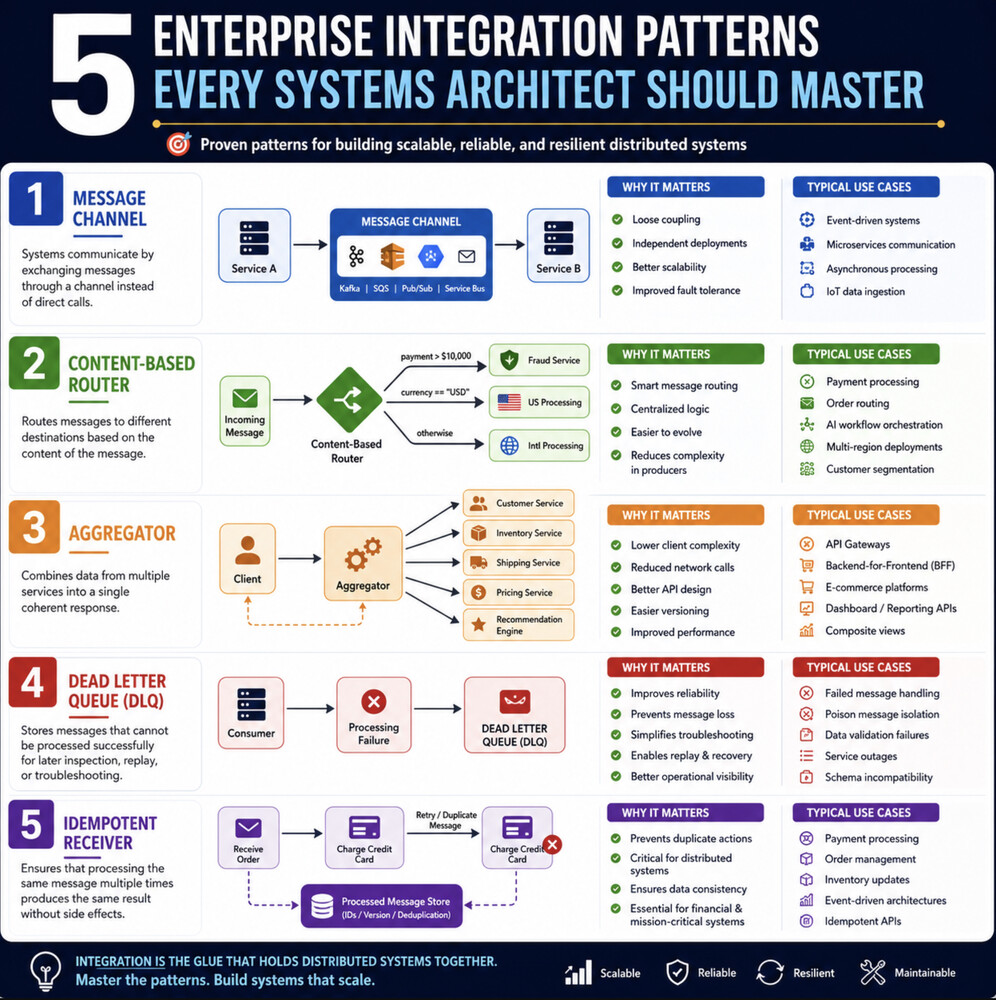
Modern systems don't fail because they're poorly coded. They fail because they don't communicate reliably.
As organizations embrace microservices, cloud-native architectures, AI agents, SaaS platforms, and event-driven systems, integration has become the backbone of enterprise software.
Unfortunately, many projects still rely on ad hoc REST calls and tightly coupled services, creating fragile architectures that become difficult to scale, evolve, and maintain.
This is exactly why Enterprise Integration Patterns (EIP) remain as relevant today as they were when first introduced.
Whether you're designing distributed systems, event-driven platforms, or AI-powered applications, mastering these patterns can dramatically improve reliability, scalability, and maintainability.
Here are five patterns every systems architect should know.
1. Message Channel
Problem
How do independent systems communicate without directly depending on each other?
Instead of one application invoking another directly, they exchange messages through a channel.
Examples include:
Apache Kafka
RabbitMQ
Amazon SQS
Google Pub/Sub
Azure Service Bus
Instead of:
Service A → Service B
You have:
Service A
    ↓
Message Channel
    ↓
Service B
Benefits
Loose coupling
Independent deployments
Better scalability
Improved fault tolerance
This simple abstraction is the foundation of modern event-driven architecture.
2. Content-Based Router
Problem
Not every message should go to the same destination.
A Content-Based Router inspects message content and decides where it should be delivered.
Example:
if payment > $10,000
    → Fraud Service

else if payment.currency == "USD"
    → US Processing

else
    → International Processing
This eliminates large conditional logic scattered across multiple services.
Typical use cases include:
Payment processing
Order routing
AI workflow orchestration
Multi-region deployments
Customer segmentation
Instead of producers making routing decisions, routing becomes centralized and easier to evolve.
3. Aggregator
Modern business processes often require data from multiple services.
Imagine an Order API.
To build a single response, it may need:
Customer Service
Inventory Service
Shipping Service
Pricing Service
Recommendation Engine
Without aggregation:
Client
   ↓
Calls five APIs
With an Aggregator:
Client
   ↓
Aggregator
   ↓
Multiple Services
The Aggregator combines multiple responses into one coherent result.
Benefits include:
Lower client complexity
Reduced network chatter
Better API design
Easier versioning
This pattern is common in API Gateways and Backend-for-Frontend (BFF) architectures.
4. Dead Letter Queue (DLQ)
Distributed systems eventually experience failures.
Messages may fail because:
Invalid data
Network interruptions
Timeouts
Service outages
Schema incompatibility
Without a DLQ:
Consumer crashes repeatedly
With a DLQ:
Consumer
   ↓
Failure
   ↓
Dead Letter Queue
Operations teams can inspect, replay, or repair failed messages without affecting production traffic.
A DLQ dramatically improves operational resilience.
One of the biggest mistakes in enterprise integration is assuming every message will succeed.
It won't.
Design for failure from day one.
5. Idempotent Receiver
Distributed systems frequently deliver duplicate messages.
Reasons include:
Retries
Network failures
Consumer restarts
At-least-once delivery semantics
Without idempotency:
Receive Order
↓
Charge Credit Card
↓
Retry
↓
Charge Again ❌
An Idempotent Receiver ensures processing the same message multiple times produces exactly the same outcome.
Common techniques include:
Unique message IDs
Database deduplication
Event versioning
Processed-message tables
Optimistic locking
If you're building financial systems, healthcare platforms, logistics software, or AI pipelines, idempotency is not optional.
It's essential.
Why These Patterns Matter More Than Ever
Today's architectures are far more distributed than they were a decade ago.
We're integrating:
Microservices
AI Agents
LLMs
SaaS APIs
Event Streams
Serverless Functions
Edge Computing
The complexity isn't in writing business logic.
It's in ensuring hundreds of services communicate reliably under constant change.
Enterprise Integration Patterns provide a proven vocabulary for solving these challenges.
They transform distributed systems from fragile collections of APIs into resilient, scalable platforms.
Final Thoughts
Technology stacks will continue to evolve.
Today's Kafka could become tomorrow's streaming platform.
Today's REST APIs may increasingly be complemented by event streams, AI workflows, or agent-based communication.
But the underlying integration principles remain remarkably stable.
Great architects don't simply choose the latest technology—they understand the timeless patterns that make complex systems reliable.
Master these five Enterprise Integration Patterns, and you'll build systems that are easier to scale, easier to maintain, and far more resilient in production.
Which Enterprise Integration Pattern has saved your project the most? Or is there another EIP you think every architect should master? Share your experience in the comments.