
25 System Design Patterns Every Software Architect Should Know
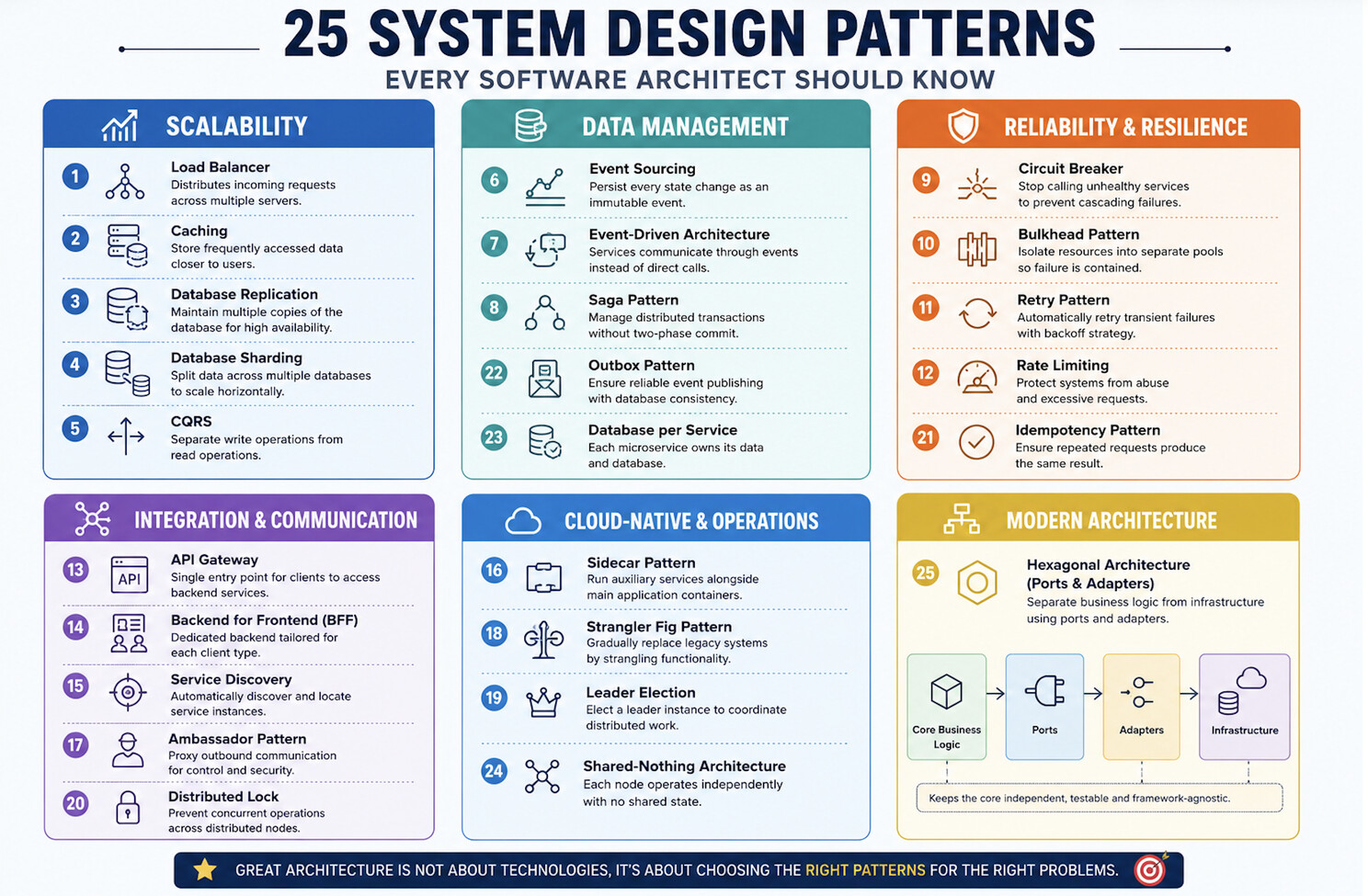
Software architecture isn't about memorising technologies.
It's about recognising patterns.
The best architects don't reinvent solutions for every new project. They identify recurring problems, understand the trade-offs, and apply proven design patterns that have been validated by thousands of production systems.
Whether you're designing a startup application or a global platform serving millions of users, you'll encounter many of the same architectural challenges:
How do you scale?
How do you ensure reliability?
How do you reduce latency?
How do you integrate services?
How do you protect data?
How do you evolve without breaking everything?
This is where system design patterns become invaluable.
Here are 25 essential system design patterns every software architect should master.
1. Load Balancer
Distributes incoming requests across multiple servers.
Why it matters
Eliminates single-server bottlenecks
Improves availability
Enables horizontal scaling
Examples
NGINX
HAProxy
AWS Application Load Balancer
2. Caching
Store frequently accessed data closer to users.
Benefits
Lower latency
Reduced database load
Better user experience
Examples
Redis
Memcached
CDN caching
3. Database Replication
Maintain multiple copies of the database.
Advantages
High availability
Read scalability
Disaster recovery
Common model:
One primary
Multiple read replicas
4. Database Sharding
Split data across multiple databases.
Ideal when a single database can no longer handle traffic.
Typical sharding keys:
User ID
Region
Customer ID
Tenant ID
5. CQRS (Command Query Responsibility Segregation)
Separate write operations from read operations.
Benefits:
Independent scaling
Optimised read models
Better performance
Common in high-scale enterprise systems.
6. Event Sourcing
Persist every state change as an immutable event.
Advantages:
Complete audit trail
Easy replay
Temporal debugging
Regulatory compliance
Popular in fintech and banking.
7. Event-Driven Architecture
Services communicate through events instead of direct API calls.
Benefits:
Loose coupling
Better scalability
Improved resilience
Common technologies:
Kafka
RabbitMQ
Amazon EventBridge
8. Saga Pattern
Manage distributed transactions without two-phase commit.
Approaches:
Choreography
Orchestration
Essential for microservices.
9. Circuit Breaker
Stop calling unhealthy services.
Benefits:
Prevent cascading failures
Faster recovery
Improved resilience
Libraries:
Resilience4j
Hystrix (legacy)
10. Bulkhead Pattern
Isolate resources into separate pools.
Similar to watertight compartments on ships.
Failure in one area doesn't sink the whole system.
11. Retry Pattern
Automatically retry transient failures.
Best practices:
Exponential backoff
Jitter
Maximum retry limit
12. Rate Limiting
Protect systems from abuse.
Methods:
Token Bucket
Leaky Bucket
Fixed Window
Sliding Window
Widely used in API gateways.
13. API Gateway
Single entry point for clients.
Responsibilities:
Authentication
Routing
Rate limiting
Logging
Request aggregation
Examples:
Kong
Spring Cloud Gateway
AWS API Gateway
14. Backend for Frontend (BFF)
Dedicated backend per client type.
Examples:
Mobile API
Web API
Smart TV API
Benefits:
Faster front-end development
Client-specific optimisation
Reduced over-fetching
15. Service Discovery
Automatically locate service instances.
Popular options:
Eureka
Consul
Kubernetes DNS
Critical for dynamic environments.
16. Sidecar Pattern
Deploy helper services alongside applications.
Common uses:
Logging
Monitoring
Security
Service mesh
Examples:
Envoy Proxy
Istio
17. Ambassador Pattern
Proxy outbound communication.
Benefits:
Centralised networking
Security
Traffic management
18. Strangler Fig Pattern
Gradually replace legacy systems.
Instead of rewriting everything:
Old System
↓
New Components
↓
Complete Migration
Lower risk.
Higher success rate.
19. Leader Election
Elect one instance to coordinate distributed work.
Common scenarios:
Scheduler
Batch processing
Cluster coordination
20. Distributed Lock
Prevent concurrent operations across nodes.
Examples:
Redis Lock
ZooKeeper
etcd
Useful for inventory, payments and scheduling.
21. Idempotency Pattern
Repeated requests produce the same result.
Critical for:
Payment APIs
Order creation
Distributed retries
Avoids duplicate processing.
22. Outbox Pattern
Guarantee database updates and event publishing stay consistent.
Workflow:
Write business data
Write outbox event
Background publisher sends message
Widely adopted in microservices.
23. Database per Service
Each microservice owns its data.
Benefits:
Loose coupling
Independent deployment
Autonomous teams
Avoid shared databases whenever possible.
24. Shared-Nothing Architecture
Each node operates independently.
Advantages:
Horizontal scalability
Fault isolation
Cloud-native design
Foundation of many internet-scale systems.
25. Hexagonal Architecture (Ports & Adapters)
Separate business logic from infrastructure.
Your domain should never depend on:
Database
Framework
UI
External APIs
Instead:
Core Business Logic
↓
Ports
↓
Adapters
↓
Infrastructure
This makes systems easier to test, maintain and evolve.
Final Thoughts
The biggest mistake architects make isn't choosing the wrong technology.
It's applying the wrong pattern to the wrong problem.
Great software architecture isn't about using microservices, Kafka, Kubernetes, or the latest cloud platform.
It's about understanding the forces at play—scalability, consistency, availability, latency, resilience, maintainability and cost—and selecting the patterns that best balance those trade-offs.
The most successful systems are rarely built on a single architectural pattern. They combine multiple patterns to address different concerns:
API Gateway + BFF for client communication
CQRS + Event Sourcing for complex business domains
Cache + Load Balancer + Replication for high performance
Saga + Outbox + Idempotency for reliable distributed workflows
Circuit Breaker + Retry + Bulkhead for resilience
Sidecar + Service Discovery for cloud-native operations
As your systems grow, your ability to recognise and apply these patterns becomes one of the most valuable skills you can develop as a software architect.
Which system design pattern has had the biggest impact on the systems you've built? Share your experience in the comments—I’d love to hear your insights.