
25 AI Engineering Patterns Every Software Engineer Should Know
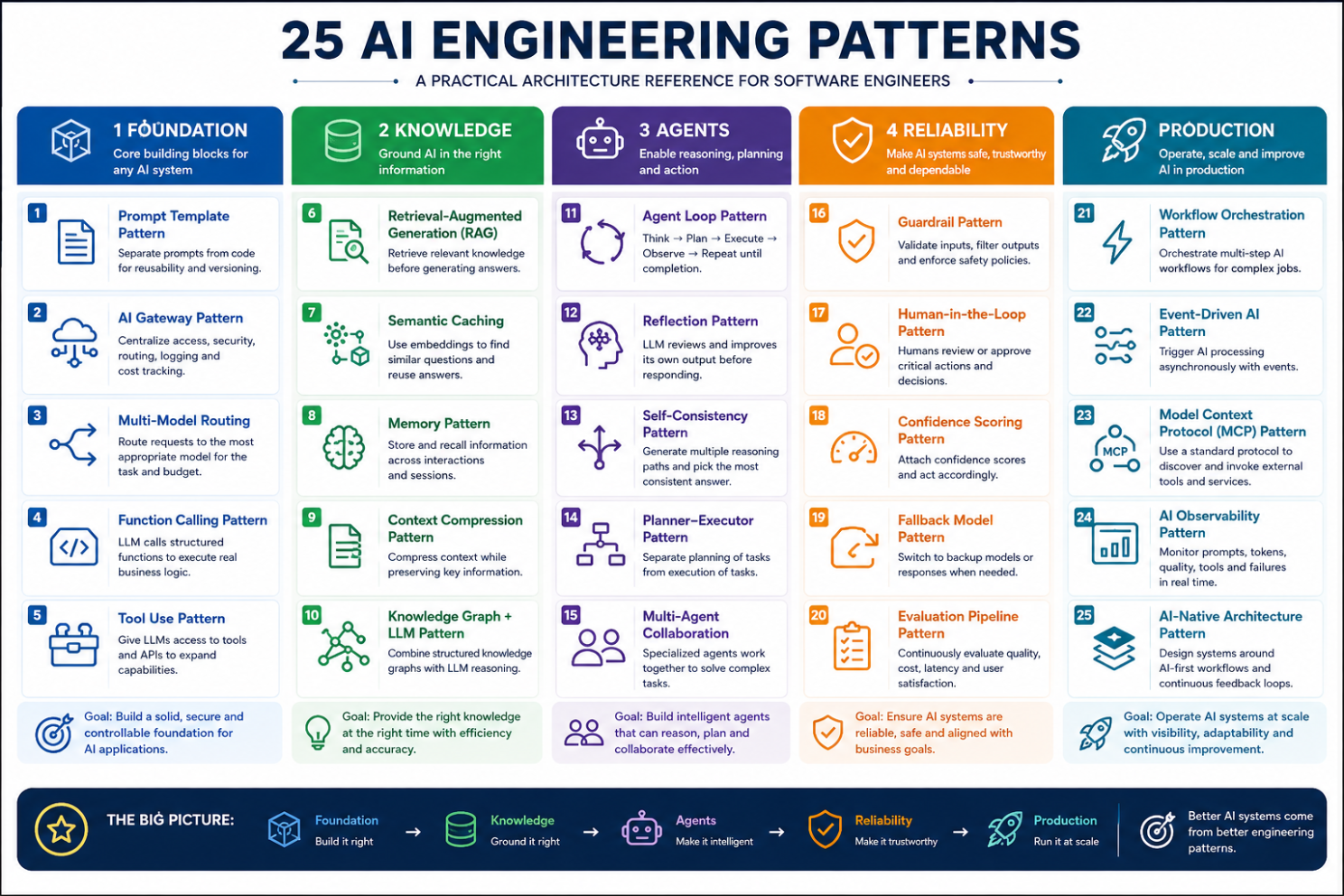
Artificial Intelligence is no longer just a feature—it's becoming part of the software architecture itself.
A few years ago, building an application meant designing APIs, databases, and user interfaces.
Today, engineers are also designing AI workflows, prompt pipelines, retrieval systems, agent orchestration, memory management, and model evaluation frameworks.
The challenge?
Many software engineers understand microservices, event-driven architecture, and distributed systems...
...but relatively few understand the architectural patterns that make AI applications reliable, scalable, and production-ready.
After studying production AI systems and enterprise implementations, I've found these 25 AI engineering patterns appear again and again.
1. Prompt Template Pattern
Separate prompts from application code.
Instead of hardcoding prompts throughout your application, treat them like configuration.
Benefits:
Easier maintenance
Version control
A/B testing
Better collaboration
Think of prompts as the SQL queries of AI applications.
2. Retrieval-Augmented Generation (RAG)
Instead of relying solely on model knowledge:
LLM → Retrieve Relevant Documents → Generate Response
Advantages:
Up-to-date information
Lower hallucination rates
Domain-specific expertise
No model retraining
This is becoming the default architecture for enterprise AI.
3. Semantic Caching
Traditional cache:
Question → Exact Match
AI cache:
Question → Embedding Similarity → Cached Answer
This dramatically reduces:
Latency
API costs
Model requests
Perfect for customer support and internal knowledge assistants.
4. AI Gateway Pattern
Just like API Gateways...
An AI Gateway centralises:
Authentication
Rate limiting
Cost tracking
Model routing
Prompt logging
Security policies
One entry point for every AI request.
5. Multi-Model Routing
Not every task needs the biggest model.
Route requests intelligently.
Example:
Small model → Classification
Medium model → Summarisation
Large model → Complex reasoning
Vision model → Images
Speech model → Audio
Reduce costs without sacrificing quality.
6. Function Calling Pattern
LLMs shouldn't perform business logic.
Instead:
LLM → Structured Function Call → Backend Service
Examples:
Create order
Book appointment
Query CRM
Update database
Keep AI responsible for reasoning—not transactions.
7. Tool Use Pattern
Modern AI becomes dramatically more useful when it can access tools.
Examples:
Calculator
Search engine
SQL database
REST API
Calendar
Email
File system
An AI without tools is like a developer without the internet.
8. Agent Loop Pattern
Instead of a single prompt:
Think
↓
Plan
↓
Execute
↓
Observe
↓
Repeat
The agent iterates until the task is complete.
Essential for complex automation.
9. Reflection Pattern
Before returning an answer:
Generate
↓
Review
↓
Improve
The model critiques its own response.
Quality improves significantly with minimal additional complexity.
10. Self-Consistency Pattern
Ask the model multiple times.
Compare reasoning paths.
Select the most consistent answer.
Especially valuable for:
Mathematics
Coding
Logical reasoning
11. Planner–Executor Pattern
Separate planning from execution.
Planner:
"What should be done?"
Executor:
"Do it."
This improves modularity and simplifies debugging.
12. Multi-Agent Collaboration
Instead of one general-purpose agent:
Create specialists.
Examples:
Research Agent
Coding Agent
Testing Agent
Security Agent
Documentation Agent
Each excels in its own domain.
13. Memory Pattern
Without memory...
Every interaction starts from zero.
Memory enables:
User preferences
Conversation history
Long-running tasks
Personalisation
Memory transforms chatbots into assistants.
14. Context Compression Pattern
Context windows are limited.
Compress conversation while preserving important facts.
Benefits:
Lower token usage
Lower costs
Better performance
15. Guardrail Pattern
Never trust raw model output.
Add safeguards such as:
Input validation
Output filtering
Policy enforcement
PII detection
Toxicity detection
Prompt injection defence
AI applications require security engineering.
16. Human-in-the-Loop Pattern
AI makes recommendations.
Humans approve important actions.
Ideal for:
Financial systems
Healthcare
Legal
Enterprise workflows
Automation with accountability.
17. Confidence Scoring Pattern
Every AI response should include confidence.
High confidence:
Respond immediately.
Low confidence:
Ask clarifying questions.
Very low confidence:
Escalate to a human.
18. Evaluation Pipeline Pattern
Don't rely on intuition.
Continuously measure:
Accuracy
Hallucination rate
Cost
Latency
User satisfaction
Task success
What gets measured gets improved.
19. Fallback Model Pattern
If the primary model fails:
Automatically switch to:
Another provider
Smaller model
Local model
Cached response
High availability matters for AI too.
20. Workflow Orchestration Pattern
Complex AI systems involve multiple steps.
Example:
OCR
↓
Information Extraction
↓
Validation
↓
Reasoning
↓
Report Generation
Workflow orchestration improves reliability and observability.
21. Event-Driven AI Pattern
Instead of synchronous requests:
Events trigger AI processing.
Examples:
New email
Uploaded document
Customer purchase
Support ticket
Code commit
Ideal for scalable enterprise systems.
22. Knowledge Graph + LLM Pattern
Combine structured knowledge with generative AI.
Benefits:
Better reasoning
Relationship discovery
Explainability
More accurate enterprise answers
This pattern is gaining traction in regulated industries.
23. Model Context Protocol (MCP) Pattern
Instead of building custom integrations for every tool...
Use a standard protocol that allows AI applications to securely discover and invoke external capabilities.
Benefits:
Standardised tool integration
Reduced integration effort
Better portability
Cleaner architecture
Easier governance
MCP is rapidly becoming an important interoperability layer for AI systems.
24. AI Observability Pattern
Monitor more than infrastructure.
Track:
Prompt versions
Token consumption
Response quality
Tool usage
Failure reasons
Hallucination trends
If you can't observe it, you can't improve it.
25. AI-Native Architecture Pattern
The most advanced systems aren't simply "AI-enabled."
They're designed around AI from day one.
Characteristics include:
AI-first workflows
Event-driven orchestration
Autonomous agents
Tool ecosystems
Continuous evaluation
Feedback loops
Secure governance
Human oversight where required
This represents the next evolution of software architecture.
Final Thoughts
Software engineering isn't being replaced by AI.
It's being expanded.
The engineers who thrive over the next decade won't just know Java, Python, Kubernetes, cloud platforms, or distributed systems.
They'll understand how to design systems where models, tools, data, workflows, and humans work together as a cohesive architecture.
The future belongs to engineers who can combine classical software engineering principles with modern AI engineering patterns to build systems that are intelligent, trustworthy, and scalable.
Which AI engineering pattern has had the biggest impact on your projects—or which one are you planning to explore next? Let's discuss in the comments.